Assessment of Public Conservation Lands Vulnerable to E. Coli–Impaired Streams in Missouri
Landscape Analysis (GEO 669) · ArcGIS Pro · Spatial Overlay · 10 km Buffer
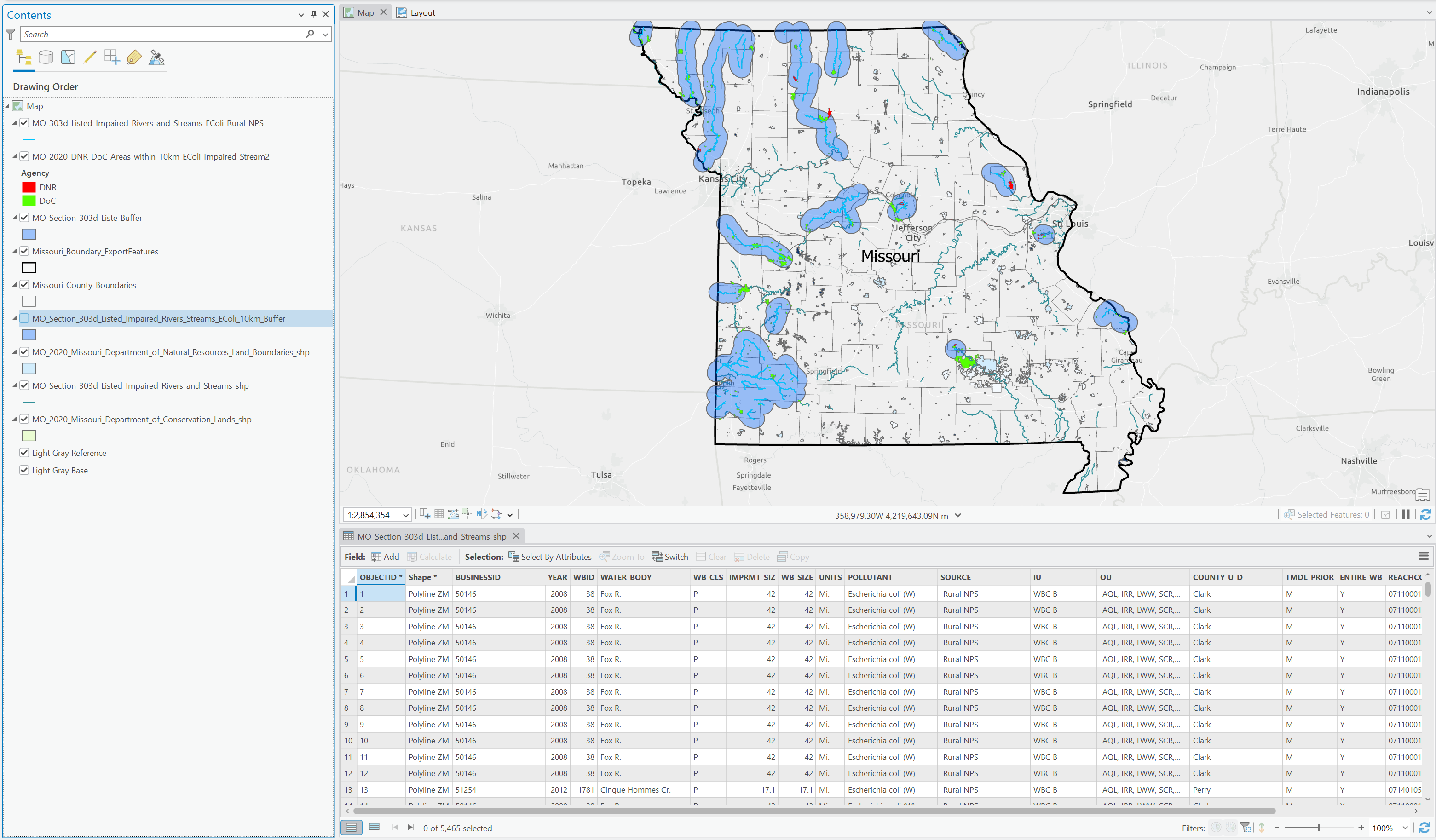
Identified public conservation lands potentially impacted by proximity to E. coli–impaired waterways. Filtered Missouri’s 303(d) list (Rural NPS), generated a 10 km buffer, merged DNR & DoC lands, and intersected to map priority zones.
This project identified public conservation lands that may be environmentally vulnerable due to proximity to E. Coli-impaired waterways. Using datasets from the Missouri Spatial Data Information Service (MSDIS), Department of Natural Resources (DNR), and Department of Conservation (DoC), I performed a spatial overlay analysis in ArcGIS Pro to locate areas within 10 km of 303(d)-listed rural nonpoint source streams impaired by Escherichia coli.
The analysis involved filtering impaired streams, generating a 10 km buffer, merging DNR and DoC land boundaries, and selecting lands intersecting the buffer zone. The final map highlights public conservation areas most at risk of waterborne contamination, supporting informed land management and watershed protection planning.
Tools & Techniques
- ArcGIS Pro
- Select By Attributes
- Buffer
- Merge
- Select By Location
- Symbology
- Cartographic Layout
Data Sources
- Missouri Spatial Data Information Service (MSDIS) 2020
- Missouri Department of Natural Resources (DNR)
- Missouri Department of Conservation (DoC)
Precipitation Interpolation and Watershed-Based Rainfall Normalization — Minnesota, August 2007
Landscape Analysis (GEO 669) · ArcGIS Pro · Spatial Analyst · Ordinary Kriging · Zonal Statistics
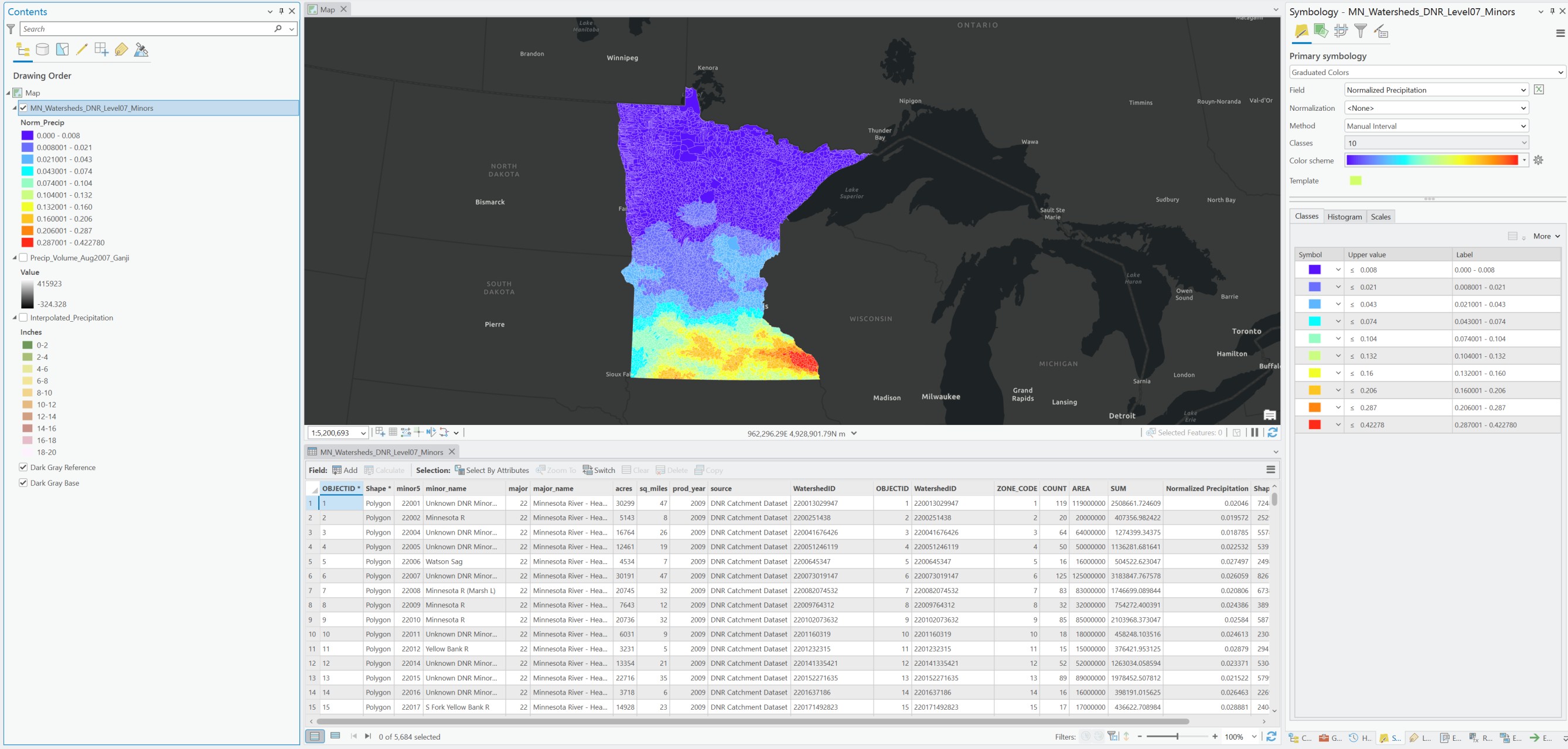
Modeled statewide rainfall distribution from station observations using Ordinary Kriging (Exponential model) in ArcGIS Pro. Converted interpolated precipitation (inches) to rainfall volume (m³) and calculated total and normalized precipitation per Level-07 minor watershed across Minnesota.
This project demonstrates a full hydrologic GIS workflow to analyze the spatial variability of an extreme rainfall event (August 18–20, 2007) in Minnesota. Starting from rain gauge data (Easting/Northing coordinates and rainfall totals in inches), point features were created and projected to NAD 1983 (2011) UTM Zone 15N. Using Ordinary Kriging with an exponential semivariogram, a continuous precipitation surface was generated at a 1 km cell resolution.
The interpolated raster was converted from inches to meters and multiplied by cell area (1 km² = 1,000,000 m²) to derive rainfall volume (m³) per grid cell. Zonal Statistics summarized total rainfall volume within each Level-07 minor watershed, and normalized precipitation (m³/m²) was computed by dividing total volume by watershed area. The final map highlights regional gradients and localized extremes in rainfall intensity, supporting hydrologic modeling and flood risk assessment.
Tools & Techniques
- ArcGIS Pro (Spatial Analyst)
- XY Table To Point
- Project
- Ordinary Kriging (Exponential Semivariogram)
- Raster Calculator
- Zonal Statistics as Table
- Field Calculator
- Symbology with .lyrx Files
- Cartographic Layout & Export
Data Sources
- Rain Gauge Data (UTM NAD 1983 Zone 15N, August 2007)
- Minnesota Department of Natural Resources (DNR) — Watershed Boundaries
- USGS National Hydrography Dataset
Line-of-Sight Viewshed Analysis for Wireless Coverage & Monitoring - Minnesota state,Winona County
Landscape Analysis (GEO 669) · ArcGIS Pro · DEM-based visibility · Observer points & tower height
Overall Objective
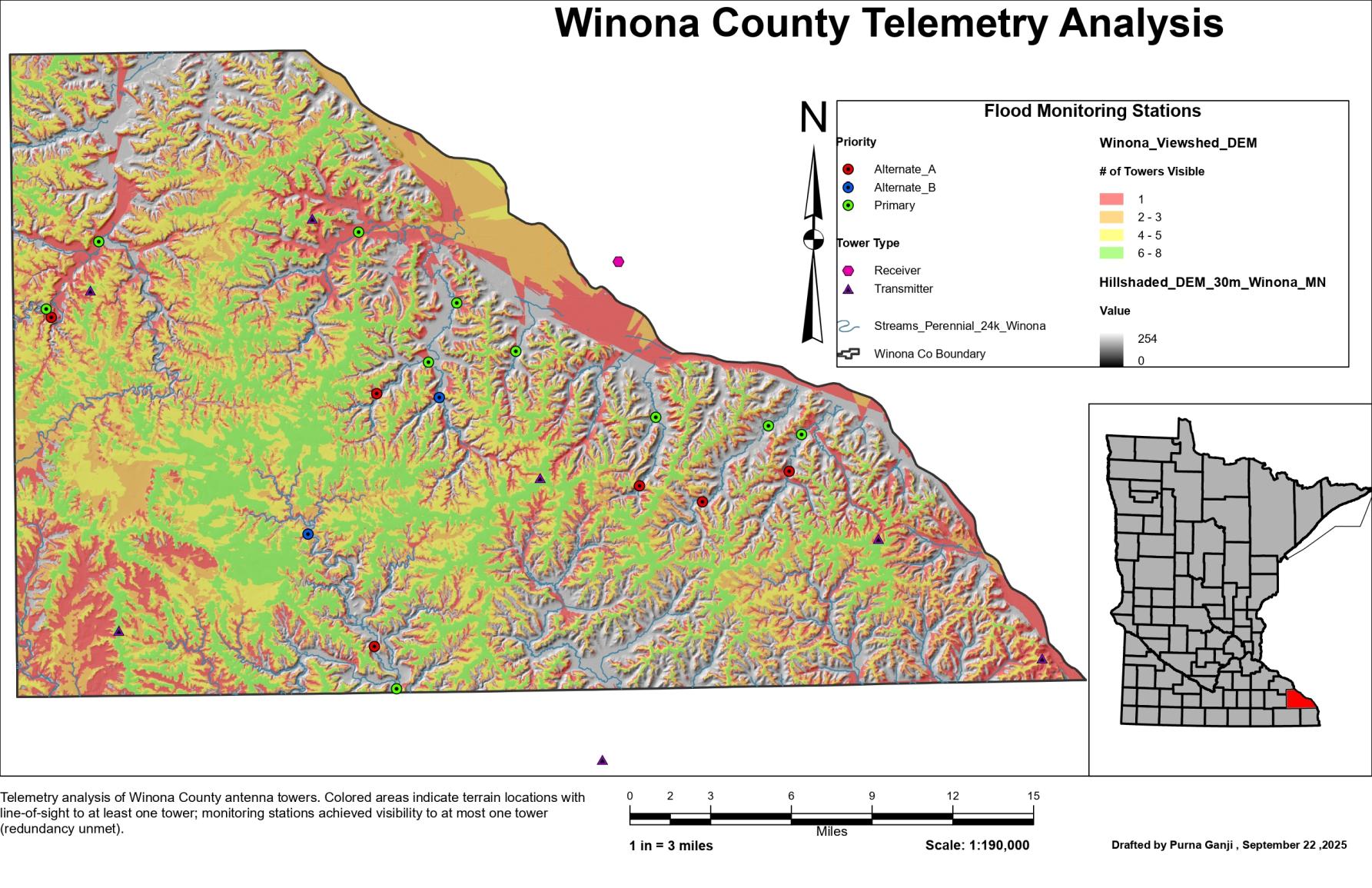
Evaluate whether Winona County flood-monitoring stations can transmit via line-of-sight (LOS) radio to existing 800-MHz antenna towers with redundancy (each station must see ≥ 2 towers). Run a Geodesic Viewshed on a 30-m DEM to quantify visibility, then summarize per-station tower counts to determine viability.
Project Description
1) Study Area Setup
- Created a project geodatabase and added statewide foundational layers.
- Subset to Winona County:
- Winona County boundary (for map extent and output mask).
- Clipped 30-m DEM to Winona County; generated hillshade for cartography.
- National Hydrography Dataset (NHD) Flowline filtered to perennial streams for context.
2) Viewshed Modeling (Physics)
Configured Geodesic Viewshed (accounts for Earth curvature and standard atmospheric refraction) with:
- Observer offset (
OFFSETA): 305 m (tower antenna height above ground) - Surface/target offset (
OFFSETB): 3 m (station antenna height at flood-monitoring site) - Analysis type: Frequency (each raster cell stores the number of towers with LOS to that cell)
- Angular limits: Horizontal 0–360°; Vertical +90° to −90° (full dome)
- Environments: Snap Raster = DEM; Cell Size = 30 m; Mask = Winona County; Z-factor = 1 (DEM in meters)
3) Per-Station Visibility & Redundancy
- Ran Extract Multi Values to Points to sample the viewshed frequency at each station point.
- Wrote the sampled value to a field
TowersSeen(number of towers in LOS from that station). - Evaluated the redundancy rule:
TowersSeen ≥ 2required for LOS feasibility at each station.
4) Cartography & Communication
- Classified the frequency raster for the map legend using intuitive bins:
- 1 (single tower)
- 2–3 (basic redundancy)
- 4–5 (strong redundancy)
- 6–8 (excellent redundancy)
- Placed semi-transparent frequency raster over hillshade for terrain context.
- Symbolized stations by priority (meets ≥ 2 towers vs. does not) and towers by type.
- Added perennial streams and a Minnesota inset highlighting Winona County.
Data Sources
- Digital Elevation Model (30 m, statewide): elevation surface used for geodesic viewshed.
- State Boundary (Minnesota): polygon for inset/context.
- County Boundaries (Minnesota): polygons; Winona extracted for mask and extent.
- NHD High Resolution – Flowline: lines; filtered to perennial streams (FCode 46006).
- Antenna Towers (800 MHz): assignment-provided observer points.
- Flood Monitoring Stations: assignment-provided target points.
Coordinate Systems / Projections
- Working / map projection (recommended & used): NAD 1983 / UTM Zone 15N (EPSG: 26915) or NAD 1983 (2011) / UTM Zone 15N (EPSG: 6339).
- Rationale: preserves local distances/areas; keeps DEM units (meters) aligned with offsets (m) and cell size (30 m).
- Raster environment: Cell Size = 30 m, Snap Raster = DEM, Z-factor = 1.
- Output mask: Winona County polygon (tidy outputs and cleaner layout).
Assumptions & QA/QC
- Earth curvature/refraction: geodesic method enabled; standard refractivity assumed.
- Heights: 305 m tower
OFFSETA, 3 m stationOFFSETBapplied consistently. - DEM suitability: 30-m resolution adequate for county-scale planning; sub-30-m terrain features (buildings/trees) not modeled.
- Layer validation: verified tower and station locations, projected all layers to the working CRS, ensured consistent units.
Results (Findings)
- The frequency viewshed raster returned integer values from 1–6 across Winona County.
- When sampled at station points,
TowersSeenwas 0 or 1 at all stations (cells with no visibility are NoData and treated as 0 in the table). - Redundancy test: No stations achieved
≥ 2towers visible at their current locations – the redundancy requirement was not met.
Conclusion
Given current tower placement and local terrain (bluffs/valleys), LOS telemetry does not provide redundant connectivity for the flood-monitoring stations in Winona County. The county-scale geodesic viewshed on the 30-m DEM indicates stations see at most one tower (or none), failing the ≥ 2-tower redundancy criterion.
Implications / Next Steps
- Network design: Add/relocate towers or repeaters to overcome terrain blocking in valleys.
- Site engineering: Increase station mast heights where feasible; re-site stations onto local ridgelines.
- Alternate backhaul: Evaluate cellular/microwave/satellite where LOS cannot achieve ≥ 2-tower visibility.
- Higher-resolution terrain: Consider LiDAR-derived DEM/DSM with clutter (vegetation/buildings) for micro-siting.
- Sensitivity tests: Re-run viewsheds with varied
OFFSETA/OFFSETB, and constrained azimuth/vertical angles.
Workflow
- Prepare DEM (project to common CRS; set cell size & extent)
- Create/verify observer points (towers/stations) with OFFSETA (observer height)
- Viewshed (or Viewshed 2): enable curvature/refraction as needed
- Combine observers: binary union or frequency/percent visible outputs
- Extract Multi Values to Points to count visible towers per station
- Cartographic layout (legend, scale, north arrow, credits)
Key Parameters
- Observer height (
OFFSETA) e.g., 30–60 m tower - Target height (
OFFSETB) for device/antenna at station - Earth curvature & refraction (True/False; refractivity ~0.13)
- Maximum radius / analysis extent
- Output: Binary visible, Count/Percent visible
Tools & Techniques
- ArcGIS Pro: Viewshed / Viewshed 2
- Spatial Analyst: Raster Calculator, Extract Multi Values to Points
- Data Management: Add/Calculate Field, Join, Project
- Symbology: binary/graded visibility, station counts
Deliverables
- Visibility map (single & multi-observer)
- Table: stations sorted by # of towers in LOS
Garvin Brook Watershed Delineation and Hydrologic Analysis - Minnesota
Surface Hydrology Modeling · ArcGIS Pro · LiDAR DEM · Watershed Delineation
Overall Objective
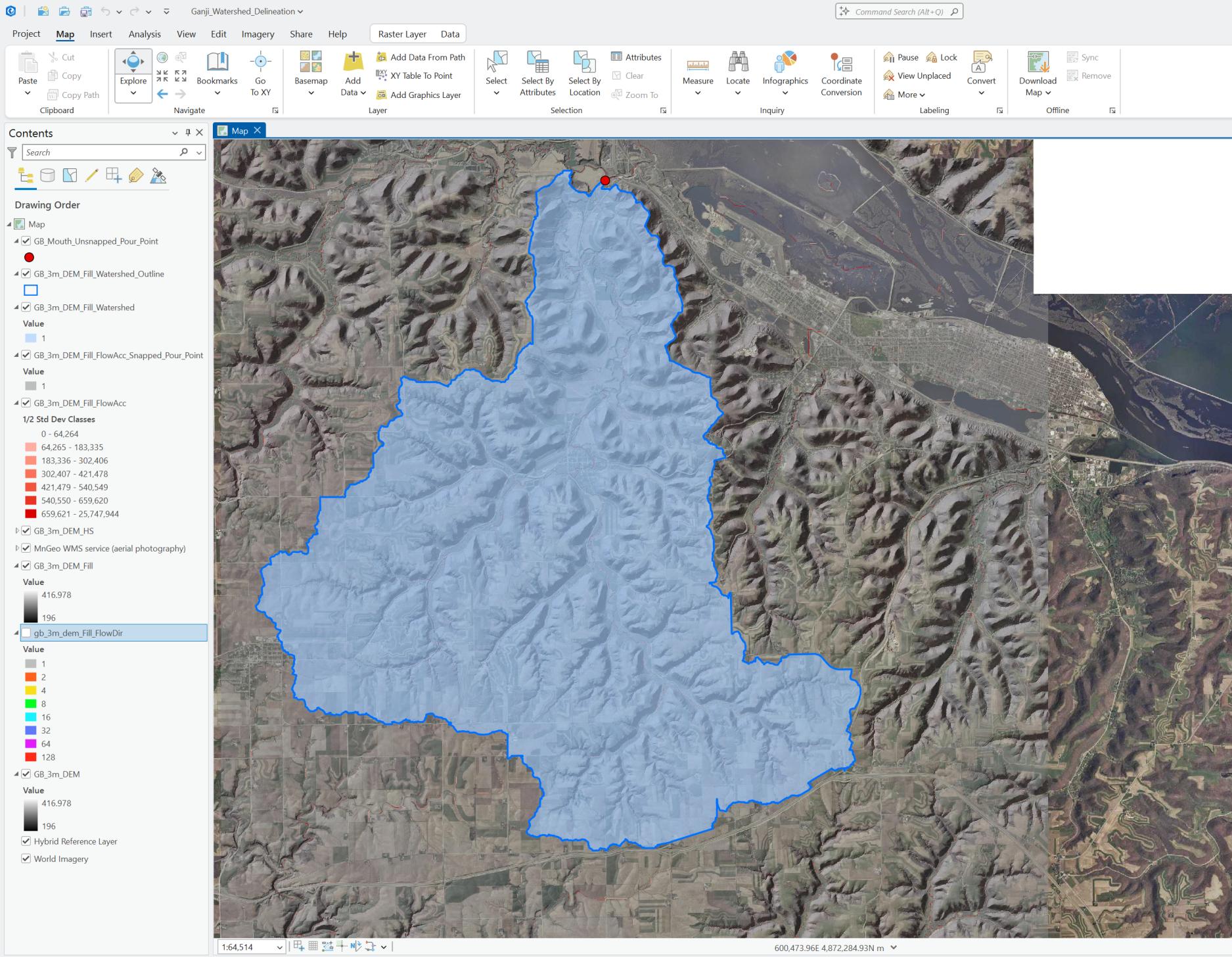
Model surface hydrology using LiDAR-derived elevation data to delineate the Garvin Brook watershed in Minnesota. Process a raw Digital Elevation Model (DEM) into a hydrologically conditioned surface, derive flow direction and flow accumulation grids, and generate an accurate watershed boundary draining to a specific outlet (pour point).
Project Description
1) Data Preparation & Terrain Processing
- Acquired 3-meter LiDAR-derived Digital Elevation Model from Minnesota Geospatial Information Office (MnGeo)
- Created hillshade raster (GB_3m_DEM_HS) for terrain visualization and validation
- Verified coordinate systems and ensured proper raster alignment for analysis
2) Hydrologic Conditioning
Applied Spatial Analyst hydrology tools to create continuous flow surfaces:
- Fill Processing: Removed spurious sinks from DEM to ensure continuous downstream flow
- Flow Direction (D8 Algorithm): Established steepest descent path for each cell in the filled DEM
- Flow Accumulation: Identified stream channels and contributing areas based on flow direction
3) Watershed Delineation
- Used Snap Pour Point tool to align the watershed outlet to the highest-accumulation channel cell (20 m search radius)
- Executed Watershed tool to delineate the contributing catchment area
- Converted raster watershed to vector polygon boundary for final output
4) Validation & Cartography
- Verified flow paths and watershed boundary against hillshade and aerial imagery
- Applied WMS imagery overlay from MnGeo for base-map context
- Used transparency blending and symbology design to create clear visualization of results
Data Sources
- GB_3m_DEM: 3-meter LiDAR-derived Digital Elevation Model from Minnesota Geospatial Information Office (MnGeo) LiDAR Program
- GB_3m_DEM_HS: Hillshade raster derived from DEM for terrain visualization
- GB_Mouth_Unsnapped_Pour_Point: Initial watershed outlet feature from course dataset
- GB_3m_DEM_Fill_FlowAcc: Pre-generated flow-accumulation raster derived from filled DEM
- MnGeo WMS (2011 Color South MN): Aerial imagery for base-map context from MnGeo Web Map Service
Coordinate Systems / Projections
- Working projection: UTM Zone 15N appropriate for Minnesota regional analysis
- Raster environment: Consistent 3-meter cell size maintained throughout processing
- Alignment: Snap raster settings ensured proper grid alignment for hydrologic tools
Assumptions & QA/QC
- D8 Algorithm: Used single-flow direction model assuming steepest descent path
- Sink Removal: Fill tool applied to eliminate all depressions for continuous flow
- Pour Point Alignment: 20-meter snap distance ensured accurate channel alignment
- Validation: Visual verification of flow paths against terrain and imagery
Results (Findings)
- Successfully generated hydrologically correct DEM (GB_3m_DEM_Fill) with continuous flow paths
- Computed accurate flow-direction grid (gb_3m_dem_Fill_FlowDir) using D8 algorithm
- Aligned pour point to stream channel using Snap Pour Point with 20-meter search radius
- Delineated precise Garvin Brook watershed boundary and converted to polygon format
- Verified watershed accuracy against aerial imagery and terrain features
Conclusion
The hydrologic modeling workflow successfully delineated the Garvin Brook watershed using LiDAR-derived elevation data. The processed DEM and derived flow products provide a reliable foundation for water-resources applications including flood analysis, drainage-area estimation, and stormwater management planning in the Winona County region.
Implications / Next Steps
- Floodplain Mapping: Use watershed boundaries for flood risk assessment and FEMA floodplain delineation
- Stormwater Modeling: Integrate with hydrologic models for runoff and peak flow calculations
- Land Use Planning: Apply watershed analysis for conservation planning and development regulations
- Higher-Resolution Analysis: Consider sub-meter DEM for more detailed channel network mapping
- Multi-direction Flow: Explore D-infinity algorithm for complex terrain situations
Workflow
- Prepare DEM (verify projection, cell size & extent)
- Apply Fill tool to remove sinks and create hydrologically correct surface
- Calculate Flow Direction using D8 algorithm
- Generate Flow Accumulation to identify stream networks
- Snap Pour Point to highest flow accumulation cell
- Delineate Watershed boundary
- Convert raster to polygon for final output
Key Parameters
- DEM Resolution: 3-meter LiDAR
- Flow Algorithm: D8 (single flow direction)
- Snap Distance: 20 meters for pour point alignment
- Sink Removal: Complete depression filling
- Output: Vector watershed polygon
Tools & Techniques
- ArcGIS Pro: Spatial Analyst Hydrology Tools
- Fill, Flow Direction, Flow Accumulation
- Snap Pour Point, Watershed
- Raster to Polygon conversion
- WMS integration for base mapping
- Hillshade generation for terrain visualization
Deliverables
- Hydrologically conditioned DEM
- Flow direction and accumulation rasters
- Watershed boundary polygon
- Professional watershed delineation map
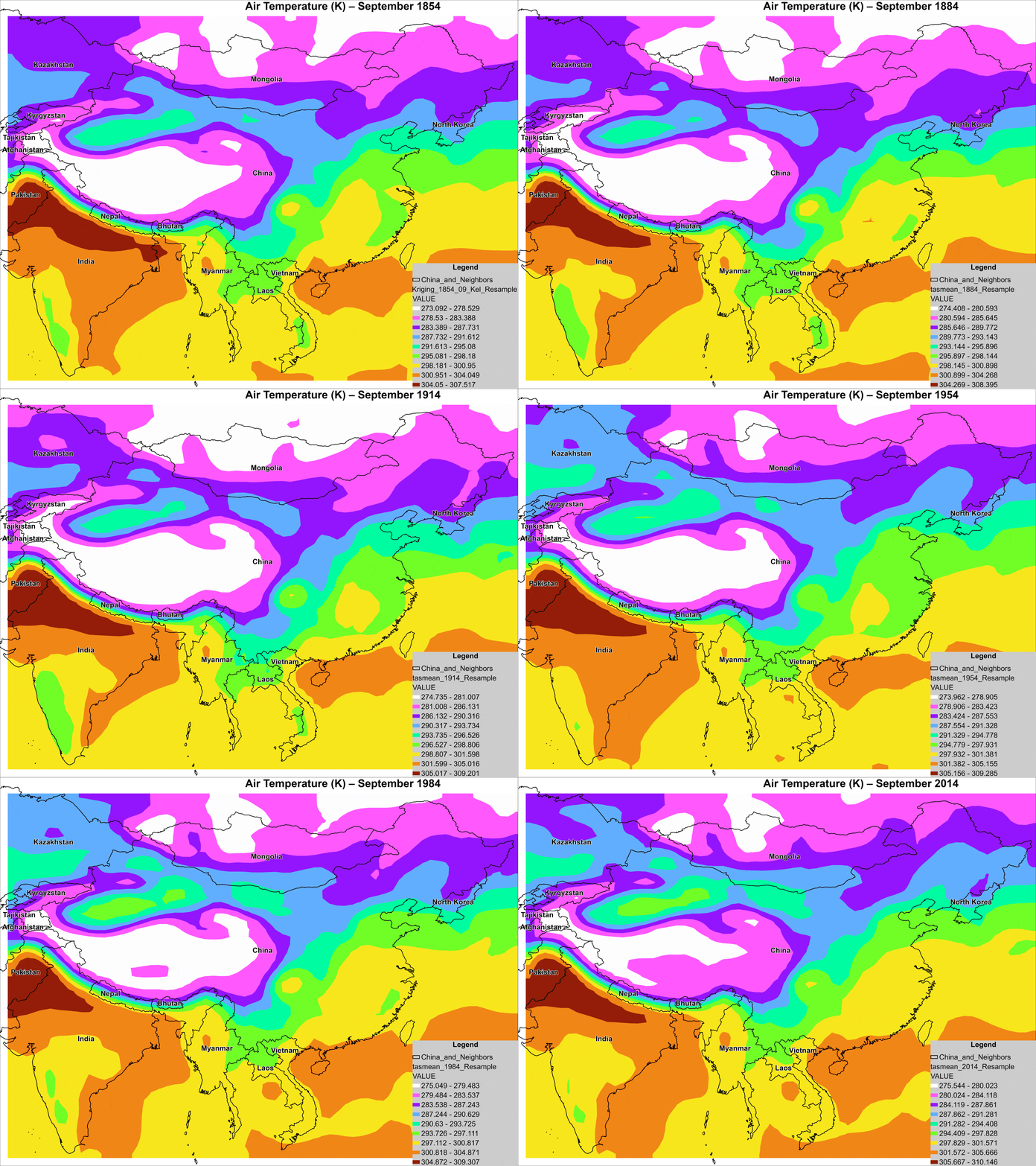
Animated Spatiotemporal Visualization of September Air Temperatures in China (1854–2014)
Climate Data Analysis · ArcGIS Pro · Kriging Interpolation · Temporal Animation
Overall Objective
Model, visualize, and animate the long-term spatial and temporal patterns of September air temperature across China from 1854 to 2014 using kriging interpolation and consistent symbology parameters, enabling clear communication of historical climate trends through geospatial animation.
Project Description
1) Data Processing & Preparation
- Collected point temperature data spanning 160 years (1854-2014) for September months
- Processed and organized temporal data into decadal intervals in ArcGIS Pro
- Applied uniform coordinate system (WGS 1984 Web Mercator Auxiliary Sphere) for spatial consistency
2) Spatial Interpolation & Surface Generation
Applied geostatistical analysis to create continuous temperature surfaces:
- Ordinary Kriging:
- Used Spatial Analyst Toolbox for optimal interpolation of point temperature data
- Raster Generation:
- Created 17 individual raster surfaces representing each time period
- Quality Control:
- Validated interpolation results against original point data
3) Cartographic Standardization
- Applied consistent symbology range (273 K – 308 K) across all 17 raster maps
- Overlaid China and neighboring country boundaries for geographic context
- Exported all maps as high-resolution PNG images at 300 DPI
4) Animation Production
- Compiled 17 raster maps into sequential animation using Python-based automation
- Configured one-second display per frame with smooth fade transitions
- Produced final animated visualization showing spatial and temporal temperature evolution
Data Sources
- Historical Temperature Records: Point temperature data for China (1854-2014)
- Administrative Boundaries: China and neighboring country polygons for map context
- Base Cartography: Reference layers for geographic orientation
Coordinate Systems / Projections
- Primary Projection: WGS 1984 Web Mercator Auxiliary Sphere
- Rationale: Ensured spatial consistency across all temporal outputs
- Standardization: Uniform coordinate reference for accurate temporal comparison
Assumptions & QA/QC
- Interpolation Method: Ordinary Kriging provided optimal surface estimation
- Temporal Resolution: Decadal intervals adequately captured climate trends
- Data Consistency: Measurement methods consistent across 160-year period
- Visual Validation: Manual verification of interpolation results against source data
Results (Findings)
- Successfully generated 17 temporally sequential temperature surfaces
- Revealed persistent north–south temperature gradient across all time periods
- Detected northward shift of warmer zones over the decades
- Identified progressive warming trend consistent with observed climate change patterns
- Produced compelling animated visualization bridging scientific analysis and visual storytelling
Conclusion
The spatiotemporal animation successfully visualized 160 years of September temperature patterns across China, clearly demonstrating both spatial gradients and temporal warming trends. The methodology combining kriging interpolation with standardized cartography and animation techniques proved effective for communicating complex climate data through intuitive visual storytelling.
Implications / Next Steps
- Climate Communication: Enhanced tools for communicating climate change impacts to diverse audiences
- Educational Applications: Valuable resource for climate science education and public awareness
- Methodological Expansion: Apply similar techniques to other climate variables and geographic regions
- Higher Temporal Resolution: Explore monthly or seasonal patterns beyond September data
- Interactive Development: Create web-based interactive versions for broader accessibility
Workflow
- Data collection and temporal organization
- Coordinate system standardization
- Ordinary Kriging interpolation
- Cartographic standardization
- High-resolution export
Key Parameters
- Time period: 1854-2014 (160 years)
- Temporal resolution: Decadal intervals
- Symbology range: 273 K – 308 K
- Output format: 300 DPI PNG sequences
- Animation: 1 second per frame with fades
Tools & Techniques
- ArcGIS Pro: Spatial Analyst Toolbox
- Ordinary Kriging Interpolation
- Python Automation
- Temporal Visualization
- Cartographic Standardization
Deliverables
- 17 interpolated temperature surfaces
- Standardized cartographic series
- Animated temperature visualization
- Temporal trend analysis